- Ballooned in 2025/26 year from P27.2 billion in 2024/25
- Gaolathe declares borrowing will remain a necessity for now
- External debt also grew to P27.88 billion
BAKANG TIRO
editors@thepatriot.co.bw
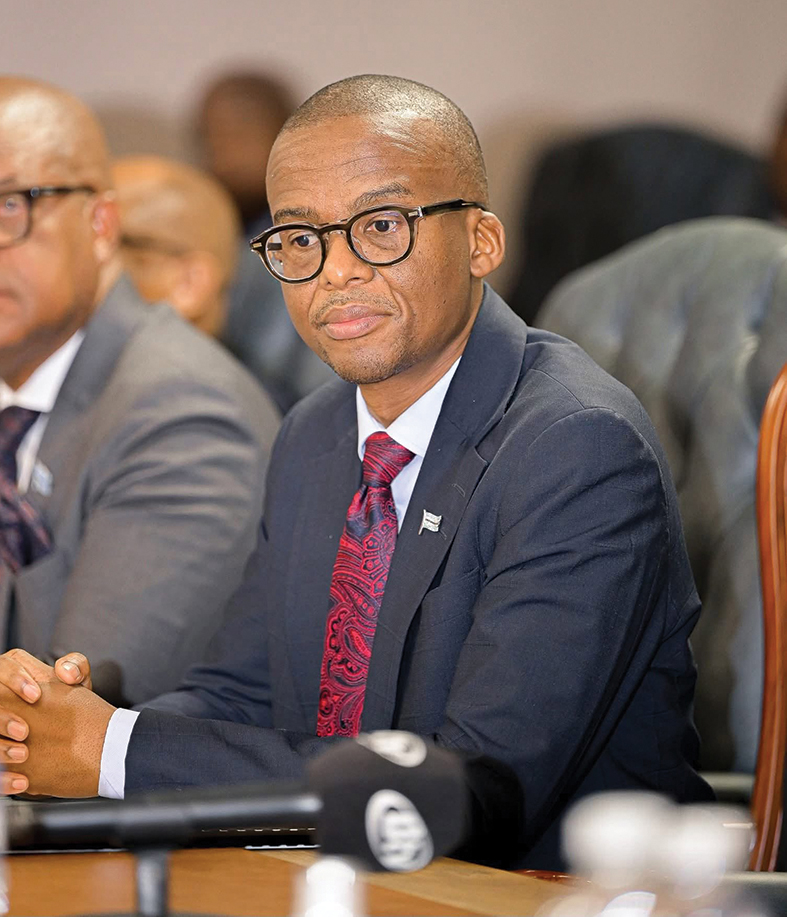
Vice President and Minister of Finance Ndaba Gaolathe has revealed that Botswana’s domestic debt doubled from P27.2 billion to P56.06 billion; a development that economic observers say will worsen over time as the economy remains subdued with no sign of positive recovery in the short to medium term.
Gaolathe revealed the government’s domestic borrowing level in Parliament this week during question time, adding that the external debt also grew from P16.4 billion in 2022/23 to P27.88 billion in the 2025/26 financial year.
He said the growth of external debt was largely reflecting the disbursement of budget-support loans from the multilateral development allies, including the African Development Bank [ADB] and the OPEC Fund. Taken together, these two borrowing components amount to P83.94 billion, he explained.
Economist Dr Mosimane Rammika said the current economic challenges will force the government to borrow, especially under the subdued mineral revenue, which has been impacted by the decline in diamond sales globally.
Dr Rammika said though domestic borrowing is higher than external debt, this is good for the country as it shows that there is money in the local market to support the government.
“Also, the borrowing rates are cheaper when compared to external borrowing. Commercial banks and pension funds have been committing money to the government, demonstrating that the local market can cushion the government. However, the high borrowing level is a burden for the government,” he said.
In addition, Dr Rammika said, when the government borrows more, it would widen the budget deficit, which would further force the government to seek more debt to sustain projects already lined up in this year’s budget.
Nonetheless, he is confident that the Botswana Economic Transformation Plan (BETP), once fully operational, it would assist the government in generating funding from projects funded at goodwill by donors or agencies.
Necessity
Gaolathe also said the government will continue to borrow for as long as financing requirements make it necessary.
However, he indicated that the government’s objective is to progressively reduce the extent to which the government depends on borrowing to finance persistent fiscal deficits. He emphasised that it is important to distinguish between borrowing and an unsustainable dependence on borrowing, particularly for productive infrastructure and investments capable of generating economic and social returns, it is a normal instrument of public finance.
Gaolathe revealed that the government doesn’t intend to rely indefinitely on borrowing to finance national operations. Rather, he said the current increase in borrowing is a response to significant fiscal and economic pressures facing Botswana, including the prolonged weakness in the diamond sector and declining mineral revenues etc.
“Government, therefore, remains committed to restoring fiscal sustainability and reducing reliance on borrowing as economic conditions improve,” said Gaolathe.
Budget Deficit
Meanwhile, Gaolathe highlighted that due to economic challenges, the budget for the 2026/27 financial projects a deficit of P26.35 billion, equivalent to approximately 8.9 per cent of Gross Domestic Product (GDP). He added that the government is therefore implementing the 2026/27 borrowing plan to finance the activities approved under the budget.
According to Gaolathe, this financing requirement will be met through a combination of domestic and external borrowing, treasury bills and bonds issuance. “It is important, therefore, to emphasize that the borrowing currently being undertaken is not unplanned. It forms part of the financing budget sanctioned by this Parliament,” he asserted.


 “(Manual Workers Union) says it is only its own participation, as a member, that can save the constitution (of the Public Service Bargaining Council). I think in this the applicant is punching way above its weight, and arrogating to… Read more: Manual workers defeated
 PALEMA KGAKATSI editors@thepatriot.co.bw RelatedPosts Manual workers defeated SADC law conference tackles democracy, regional integration BDP to retrench The University of Botswana hosted the 5th SADC International Law Conference from 7–9 October 2026 under the theme “Elections, Democracy, and Sustainable… Read more: SADC law conference tackles democracy, regional integration
 Job Description: Head of Production in Fashion, will be responsible for planning, coordination and control of manufacturing processes. Making sure goods and are produced efficiently. Correct amount is produced at the right cost and level of quality. Product design… Read more: HEAD OF PRODUCTION – FASHION
 PRESIDENT / VICE CHANCELLOR BA ISAGO University seeks to appoint a dynamic and visionary leader who will strategically position the Institution, in the national and regional tertiary education landscape, while retaining and developing its competitive edge locally. The President/Vice… Read more: BAISAGO VACANCY
 Key markets of Botswana, Croatia & SA anchor growth PBT grows to P72 million, net asset value to P2.98 billion BAKANG TIRO editors@thepatriot.co.bw RelatedPosts RDC Properties posts strong H1 results BOTHO KEY TO BETTER CUSTOMER EXPERIENCE-ACCESS BANK Botswana Households… Read more: RDC Properties posts strong H1 results