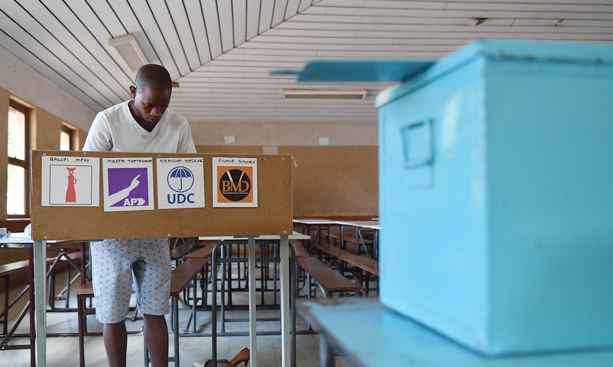
Contrary to widespread misconception that the ruling Botswana Democratic Party (BDP) was returned to power through a landslide victory last week, statistics reveal that the party only made marginal increase from the 2014 gains. A dictionary definition of the idiom ‘landslide victory’ means a victory by a large margin; a very substantial victory, particularly in an election.
The BDP was returned to power by 342 658 votes, an increase of just 22, 001 from the 320 657 recorded in 2014, thus gaining only one extra seat for Member of Parliament (MP) to make the current 38. Proportionately this figure represent 66.7 percent of the total number of seats in the August house, a slight increase from the 64.9 percent in 2014 (which made 37 MP seats). In the process, the BDP popular vote only increased from 46.5 percent in 2014 to 48.7 percent in 2019, a marginal increase of just 2.2 percent which notably remains below half (50%) the number of votes cast. However, this is a reversal of a trend where the BDP popular vote has been dropping steadily from 80 percent in 1965 to just 46.5 percent in 2014.
Numerous scholars among them Professors Maundeni, Sebudubudu and Osei-Hwedie concur that successive electoral victories by the BDP have given rise to the view that while the country operates in a multi-party framework, it is a de-facto one dominant-party system. Contributing a chapter on The Political Party System: Explaining the Predominance of the Botswana Democratic Party (BDP), in a book titled “Botswana’s Parliamentary Democracy Revisited”, High Court judge Dr Zein Kebonang and Limkokwing university Vice Chancellor Dr Gape Kaboyakgosi, also conclude that the BDP’s electoral performance is enhanced by the way in which the electoral system used in Botswana is configured. The First Past The Post (FPTP) electoral system that has been the basis of electoral contest in Botswana since 1965, has over represented the BDP and under represented the opposition in Parliament, experts have observed.
First Past The Post (FPTP) provides that victorious candidates need only obtain a simple majority.
Electoral system
Whereas opposition parties have consistently improved their popular vote, this has not necessarily translated into the same proportion of parliamentary representation. A good example is the rise in popular vote of the Botswana National Front (BNF) from 14% in 1969 to reach an all time high of 37% in 1994 before dropping after the 1998 split to 25% in 1999. Interestingly, the newly formed breakaway Botswana Congress Party BCP) garnered 11% at their first polls in 1999 rising to 19% in 2009 and reaching an all time high of 20% in 2014. In both cases the rise in popular vote did not amount to much because they could not make an outright majority. With particular reference to 2014, the combined popular vote for the three party alliance Umbrella for Democratic Change (UDC), BCP and other opposition parties collectively makes 53%.
Inversely, despite decline in popular support from an overwhelming 80% share of the popular vote during the first elections in 1965 to 65% in 1989, and the party eventually dropping to just 47% in the 2014 general elections, the BDP retains an imposing majority in Parliament.
A calculation of the total popular vote amassed by the three opposition parties which contested the 2019 elections against the BDP, being the Umbrella for Democratic Change (UDC), Botswana Patriotic Front (BPF) and the Alliance for Progressives (AP) shows that they only managed 46.8 percent. These exclude the BMD and independent candidates. The UDC is leading the pack in the opposition crowd after increasing their popular vote from 30 percent garnered in 2014 to the current 35.1 percent. Corresponding to this 5.1 percent jump in popular vote is an increase in the number of votes cast for UDC from 207 113 in 2014 to the current 247 107, an increase of 39, 994 votes.
According to the latest IEC statistic, therefore, criticism levelled against tactics employed by the leader of the Umbrella for Democratic Change (UDC), Duma Boko, which many cite as the main reason the oposition coalition failed to take power in last week polls, are unfounded. In fact, although they did not topple the BDP as intended, the UDC performed much better than before. Ironically the increase in votes, reaching almost 40 000 does not translate into an increase in Parliamentary seats for the UDC. This can be explained by the arrival of BPF and AP in the opposition block, who ate away a chunk of votes that would have naturally gone to enhance the UDC performance.
Voter apathy
Perhaps to his credit, former President Ian Khama, remains the only Head of State under whose stewardship voter turnout in Botswana surpassed the 80% mark reaching 84.60 percent at the 2014 general elections, which were won by the BDP. From the 825 582 registered to vote in 2014, a whooping 698 409 cast their vote, by far the biggest turnout ever in the history of Botswana.
The total 691, 920 votes cast in 2019 represent only 72.6 percent of the total 925 478 registered to vote, meaning that 253, 558 registered voters did not turn up at the polling stations or did not cast their vote for some other reason. From the 12 polls conducted in Botswana since 1965, the 2019 voter turnout is the 5th lowest while the smallest number of voters was recorded in 1974 (31.22%), a year of debilitating drought that had catastrophic consequences on subsistence farmers.


 AMANDA DAVID editors@thepatriot.co.bw RelatedPosts Acute water shortage stifles Zutshwa FROM SEEDLINGS TO SELF-RELIANCE Three rural women lead Botswana’s green revolution El Nino high alert Deep in the dry region of Northern Kgalagadi, residents of Zutshwa are decrying a severe… Read more: Acute water shortage stifles Zutshwa

 STAFF WRITER editors@thepatriot.co.bw RelatedPosts A new era for De Beers Inside Botswana’s Strategic Stake Realignment Banks’ total assets rise to P144 billion RDC Properties posts strong H1 results Support authors and subscribe to contentThis is premium stuff. Subscribe to… Read more: A new era for De Beers Inside Botswana’s Strategic Stake Realignment

 BY: NONOFO LEBANG In three rural villages, a new vision for community development is taking root. Through indigenous tree nurseries, three women are helping connect environmental restoration with income-generating opportunities and a more sustainable future. RelatedPosts Acute water… Read more: FROM SEEDLINGS TO SELF-RELIANCE Three rural women lead Botswana’s green revolution

 President Boko leads govt collaborative response El Nino likely to impact water, food security at household levels BAKANG TIRO editors@thepatriot.co.bw RelatedPosts Acute water shortage stifles Zutshwa FROM SEEDLINGS TO SELF-RELIANCE Three rural women lead Botswana’s green revolution El Nino… Read more: El Nino high alert