STAFF WRITER
editors@thepatriot.co.bw
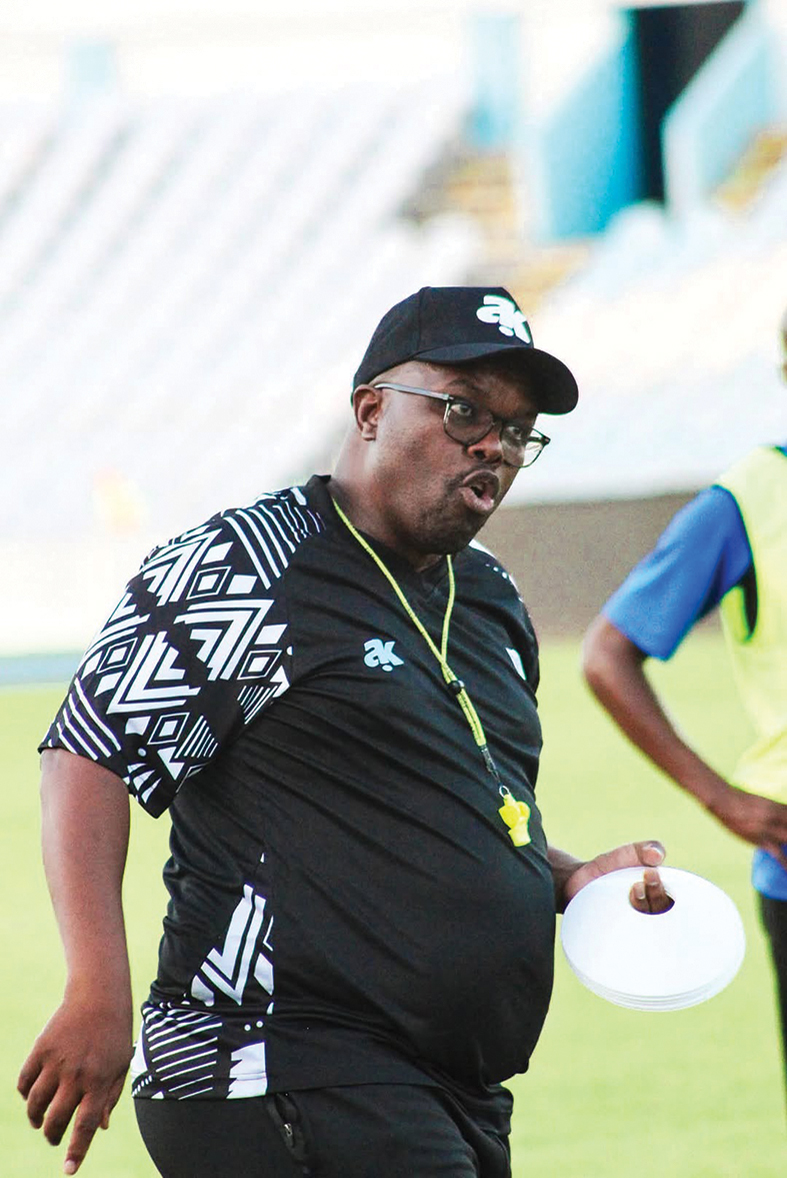
Interim Zebras coach Thaloba Nthaga enters the international qualification window carrying heavy domestic baggage. Yet, his tactical blueprint for the match against Uganda in Hoima suggests a manager entirely unbothered by off-field distractions.
Nthaga has signaled that Botswana will neither capitulate to Uganda’s notorious physical dominance nor chase an idealistic, high-risk possession game. Instead, the national team will deploy a pragmatic strategy based on strict structural discipline—proving that while the coach’s long-term future remains unwritten, his immediate tactical vision is clear.
Nthaga’s sudden, unresolved departure from Tonota FC had all the ingredients of a media circus capable of derailing a national campaign. However, he expects his squad to show a similar resilience to the controversy as they head into international duty. Rather than dodging the issue, the interim coach confronted it head-on as an occupational hazard.
“These are some of the realities of professional football, and as coaches, we must be prepared to deal with such situations,” Nthaga stated. While acknowledging his disappointment, his focus immediately shifted to forward momentum. “Naturally, I was disappointed by how things unfolded, but football teaches us resilience. You have to pick yourself up, remain focused and move forward.”
When asked to clarify his status, Nthaga revealed an ongoing administrative standoff that has left him sidelined. “I have not been training the team because the team took a position not to allow me to do that,” he added. “What I can say is that I have not resigned as the head coach of Tonota.”
When contacted for a right-of-reply, Tonota FC Chairman Tumelo Toteng flatly rejected Nthaga’s version of reality, stating unequivocally: “Nthaga is no longer our head coach and we issued a statement last week clarifying the situation.”
For a national squad preparing to enter a hostile away environment, seeing their commander treat an active club crisis as mere background noise provides stability. Nthaga made it clear that his energy is reserved for the nation, asserting that “as far as the national team is concerned, my focus and commitment remain unchanged.”
Nthaga pointed to the recent CAF Conference as a catalyst for his thinking. He spoke about the rapid modernization of the African game-specifically how elite teams manage possession, pressing triggers, transitions, and heightened physical demands. “If we want to remain competitive internationally, we must move with the times,” he warned.
But as an interim manager, Nthaga has little room for error. Rather than trying to over-engineer the Zebras’ system to mimic long-term continental trends, he admitted that many modern concepts cannot be implemented within a single international window.
For the crunch match in Hoima, his approach is filtered through immediate competitive survival, focusing on “applying the principles that are relevant to our current group and our level of preparation.”
Regarding selection criteria, Nthaga remained flexible. “Selection is a combination of several factors, including current form, regular playing time, continuity, tactical suitability, individual character and the quality of the player.” While he expressed a preference for players with regular club minutes to ensure match fitness, his baseline remains structural balance and the specific demands of the opposition.
While Nthaga kept his cards close to his chest regarding specific formations, his definition of controlling the tempo will resonate with football purists. “Controlling the tempo of a football match is not only about having possession. It is also about how effectively you organize yourself without possession, manage spaces, control transitions and influence where and how the game is played,” Nthaga explained.
This philosophy suggests a rejection of passivity without chasing an expansive, high-risk game. Nthaga explicitly warned against a submissive mentality: “We recognize Uganda’s physical qualities and the challenges of playing away, but we cannot approach such matches with the mentality that the opposition must dictate everything. If we consistently surrender possession, territory and control of the game, we make it extremely difficult for ourselves to compete and win football matches.”
Expect a Zebras side in Hoima that is highly organized, defensively rigid, and lethal on the transition. Nthaga is not promising a footballing revolution. Instead, his approach is built on pragmatic containment. If the Zebras can maintain their focus and choke Uganda’s space, Botswana might just grind out a crucial result away from home.


 STAFF WRITER editors@thepatriot.co.bw RelatedPosts The burden of Gold All set for the Jwaneng/Maun 800km AM640+ Charity Cycle Challenge Ultimate Championship, Budapest Kebinatshipi chases P1,95 million prize Interim Zebras coach Thaloba Nthaga enters the international qualification window carrying heavy… Read more: Nthaga faces Hoima test

 SOLOMON TJINYEKA editors@thepatriot.co.bw RelatedPosts El Nino pits humans against wildlife SONA 2026: Boko walking a tightrope AP, BNF push cadre deployment The Department of Wildlife and National Parks (DWNP) is anticipating an increase in human-wildlife conflicts in the coming… Read more: El Nino pits humans against wildlife

 Set eyes on unlocking potential from idling Government property Managing Director Sipho Showa confident SPV will yield back returns BAKANG TIRO editors@thepatriot.co.bw RelatedPosts Unlocking P13 billion real estate value … As Catalyst Real Estate takes shape BoB’s MONEY FLOW… Read more: Unlocking P13 billion real estate value … As Catalyst Real Estate takes shape

 Economy remains exposed to weak diamond sales shocks Boko gives the nation feedback on promises, projects etc. Secured China deals expected to lighten up Boko’s spirit Foot and Mouth update could form key part of address BAKANG TIRO editors@thepatriot.co.bw… Read more: SONA 2026: Boko walking a tightrope

 Retains rate at 5.5%, lifts a moratorium on banks’ prime lending rate Central Bank hopeful banks won’t swiftly adjust prime borrowing rates More debtors could struggle to repay loans Borrowers owe banks P70.3 billion as at December 2025 BAKANG… Read more: BoB’s MONEY FLOW GAMBLE