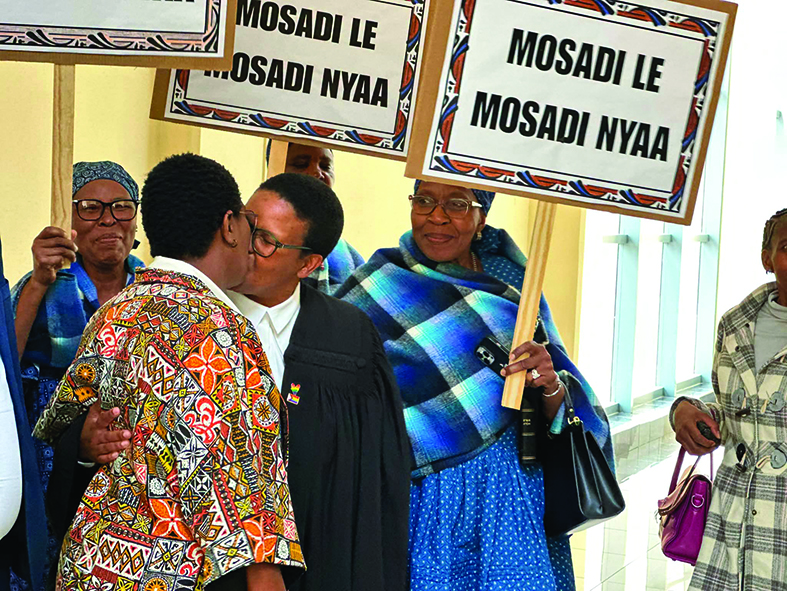
- ‘Resign or wed same sex couples” – Marriage Officers told
- ‘Court doesn’t have power to permit same-sex marriages’ – Chilisa
- Bonolo, Tsholofelo continue marriage equality battle
PALEMA KGAKATSI
& BAKWADI LEKOPANE
editors@thepatriot.co.bw
The High Court has set April 02nd 2027 as the date for delivery of judgment in the same sex marriage case, where two women – Bonolo Selelo and her partner, Tsholofelo Kumile are challenging refusal by marriage officers to join them in marriage.
Arguments in the matter started at the High Court on Thursday, and were concluded late Friday afternoon, with defense lawyers taking turns to oppose an application by two women, Bonolo Selelo and her partner, Tsholofelo Kumile, seeking to formalize their relationship through marriage.
Selelo and Kumile are challenging Section 10(2) of the Marriage Act, arguing that it violates Sections 3, 7, 12, 13 and 15 of the Constitution of Botswana by denying them equal protection of the law and marital rights.
The application by the two women is supported by minority rights advocacy group- Lesbians, Gays & Bi-Sexuals of Botswana (LEGABIBO) and Dr Onthatile Olerile Moeti as friends of the court –amicus curiae. The all-female couple are challenging the refusal by Marriage Officers to register their marriage, arguing that such conduct is unconstitutional as it denies them the right enjoyed by all other citizens.
Opposing the application is the Government of Botswana lawyers, together with the Evangelical Fellowship of Botswana (EFB), Dingwetsi Association of Botswana and Botswana House of Prayer & Transformation. Their defense is anchored on faith and culture, and the legislative powers which rest with Parliament instead of court. They are adamant that Botswana does not recognize same-sex marriages or civil unions. The Marriage Act, 2001 does not provide for the recognition of same-sex unions.
Recognizing the gravity of the court case, which pitted the couple against the Director of Civil and National Registration and others, and its constitutional significance, the Administration of Justice has allocated a full bench -five (5) Judges, to hear the matter led by Chief Justice Gaolapelwe Ketlogetswe.
Legislative power
On Friday, attorney Mboki Chilisa, opposing the application on behalf of the Government of Botswana argued that court does not have the power to create legislation that would make it permissible for same-sex couples to enter into marriage. “What this court cannot do is recognize that the Marriage Act is unconstitutional in so far as it does not make provisions for it (same sex marriages),” he submitted.
Representing Dingwetsi Association and Botswana House of Prayer Association, Advocate Reginald Wills argued that as it stands the Marriage Act provides for one man-one woman. He said the definition is constitutionally justified and that only Parliament, not the court, should legislate on same-sex marriages. “Ultimately, it is only the legislature that can cure any problem identified in the Act,” he buttressed.
Another defense lawyer, Pako Moakofhi who is representing the Evangelical Fellowship of Botswana (FB) argued that the Marriage Act is consistently gender-specific and that granting same-sex marriages would coerce Christian marriage officers against their religious conscience, so the court should not grant the relief sought.
“Freedom can primarily be characterized by the absence of coercion or constraint,” he posited.
Constitutional rights
The Department of Civil and Registration, through a letter dated 8 May 2025 refused to register and publish the banns (marriage notices) of the couple’s intended marriage. They are now seeking judicial review, claiming that the decision of the Department of Civil and Registration, as set out in the Banns Letter, was unreasonable, irrational, and illegal.
They are also seeking a constitutional challenge to the decision of the Department of Civil and Registration, claiming it violates sections 3 (Fundamental rights and freedoms of the individual), 7 (Protection from inhuman treatment), 12 (Protection of freedom of expression), 13 (Protection of freedom of assembly and association), and 15 (Protection from discrimination on the grounds of race, etc.) of the Constitution of Botswana.
The couple, LEGABIBO and Dr Moeti seek an order that section 10(2) of the Marriage Act does not exclude same-sex couples and, if found to do so, that the said exclusion violates the applicants’ constitutional rights outlined above.
This case is divided into three parts; i. Firstly, an administrative-law challenge through judicial review proceedings to the refusal, ii. Secondly, a constitutional challenge to the refusal with reliance on sections 3, 7, 12, 13 and 15 of the Constitution, and iv. Thirdly, a constitutional challenge against the validity of section 10(2) of the Marriage Act to the extent that it is found to exclude same sex couples.
The matter is not only about challenging the administration and the Marriage Act at its core, but is about whether the State can treat one group of adult citizens differently because of the sex of the person they love and want to marry and then argue that this does not affect their constitutional rights.
MARRIAGE EQUALITY BATTLE HEADS FOR APRIL 2027 RULING
Tshiamo Rantao, who is representing the organization Lesbians, Gays and Bisexuals of Botswana (LEGABIBO), Rantao argues that the Marriage Act’s gender specific language and procedural safeguards must be respected and that law making belongs to the elected Parliament under its democratic mandate as a principle that ultimately offers a positive, democratic pathway for same-sex marriage to be achieved through legislative reform rather than judicial interpretation.
“It was not given to the elected members of parliament who, in accordance with their democratic mandate, were given power to make or unmake laws and policies,” he stressed.
Attorney Mukungekwa Maswabi who also represent the LEGABIBO organization, argued that Section 10(2) of Botswana’s Marriage Act unconstitutionally excludes same-sex couples from civil marriage, which violates their rights to equality, privacy and freedom of discrimination.
Wim Trengove who represents Bonolo Selelo and Tsholofelo Kumile argues that Section 10(2)’s bride and bridegroom wording is merely an illustrative formula for secular weddings rather than an express legislative ban on same-sex marriage since Parliament would have said so expressly if it intended such a drastic exclusion and that the Marriage Act must therefore be read in conformity with the Constitution, without preferring one religion or one sexual identity over others.
He said, “the act must be interpreted … in a way which does not prefer one religion over others in a way which does not prefer one sexual identity over others.”
Chilisa argues that high court cannot permit same-sex marriage
The marriage equality case is still ongoing in the High Court today. Attorney Mboki Chilisa who is representing the defendant party’s argues that, the court cannot create legislation that would make it permissible for the same-sex couples to be in a marriage. “But what this court cannot do is recognize that the Marriage Act is unconstitutional in so far as it doesn’t make provision for it, he said.”
Advocate Reginald Wills who is representing Dingweetsi association and Botswana House of prayer association argues that the Marriage Act’s says one man-one woman definition is constitutionally justified and that only Parliament, not the court, should legislate same-sex marriage.
“But ultimately, it’s only the legislature that can cure this problem,” he elaborated.
Lawyer Pako Moakofhi, who represents the Evangelical fellowship of Botswana argues that the Marriage Act is consistently gender-specific and that granting same-sex marriage would coerce Christian marriage officers against their religious conscience, so the court should not grant the relief sought.
“Freedom can primarily be characterised by the absence of coercion or constraint,” he pointed. The judgement for the case is scheduled to be announced on the 2nd of April, 2027.


 8 percent growth in 2025 from P146.5 billion in 2024 Customer deposits & shareholder funds backed growth Businesses’ debt to banks stood at P27.2 billion in 2025 BAKANG TIRO editors@thepatriot.co.bw RelatedPosts Banks’ total assets rise to P144 billion RDC… Read more: Banks’ total assets rise to P144 billion

 ‘Resign or wed same sex couples” – Marriage Officers told ‘Court doesn’t have power to permit same-sex marriages’ – Chilisa Bonolo, Tsholofelo continue marriage equality battle PALEMA KGAKATSI & BAKWADI LEKOPANE RelatedPosts Manual workers defeated SADC law conference tackles… Read more: Govt rejects same sex marriages Dingwetsi, Church angry

 “(Manual Workers Union) says it is only its own participation, as a member, that can save the constitution (of the Public Service Bargaining Council). I think in this the applicant is punching way above its weight, and arrogating to… Read more: Manual workers defeated

 PALEMA KGAKATSI editors@thepatriot.co.bw RelatedPosts Manual workers defeated SADC law conference tackles democracy, regional integration BDP to retrench The University of Botswana hosted the 5th SADC International Law Conference from 7–9 October 2026 under the theme “Elections, Democracy, and Sustainable… Read more: SADC law conference tackles democracy, regional integration

 Job Description: Head of Production in Fashion, will be responsible for planning, coordination and control of manufacturing processes. Making sure goods and are produced efficiently. Correct amount is produced at the right cost and level of quality. Product design… Read more: HEAD OF PRODUCTION – FASHION