
PALEMA KGAKATSI
The University of Botswana hosted the 5th SADC International Law Conference from 7–9 October 2026 under the theme “Elections, Democracy, and Sustainable Economic Development in Africa’s Sub-Regions: The Current State of Affairs in Southern African development community (SADC), East African community (EAC) and Economic community of west African state (ECOWAS).”
The conference brought together academics, legal practitioners, and researchers from across SADC, ECOWAS, and the East African Community to deliberate on strategies shaping the region’s collective future. It was a collaboration of six leading universities across five countries, including the University of Fort Hare, the University of the Western Cape, the National University of Lesotho, Wits School of Law, the University of Lay Adventists of Kigali, and North-West University.
Funded by the Friedrich Naumann Foundation, the event also saw the launch of a major report on judicial independence and accountability in ten African countries on 8 October 2026. On the first day, Dr. Stephen Idowu Ilesanmi of the University of Ibadan presented a comparative legal analysis of green and blue economy transitions in Botswana and Nigeria under the SADC and ECOWAS frameworks. He argued that while both regions have adopted progressive environmental policies, neither possesses binding supranational enforcement mechanisms, leaving implementation weak and fragmented.
Botswana’s green economy, he noted, excels in resource efficiency but struggles to translate policy into economic opportunity, while Nigeria’s blue economy suffers from overlapping agency mandates and the absence of a dedicated law. “My analysis reveals a paradox: both regional frameworks and both countries have adopted progressive policies, yet implementation remains weak,” he pointed.
Acting vice chancellor, David Katzke, opened the conference mentioning that it is the first time the global gathering was held in Southern Africa, hosted in partnership with Democracy International. He emphasised that democracy is more than elections, it is a continuing conversation requiring trust, accountability, and inclusion, drawing parallels between Botswana’s traditional Kgotla institution and the African Union’s vision of unity and shared prosperity. He called on the university to produce responsible citizens, not just skilled professionals, who understand their rights and contribute to the public good.
“Democracy is more than elections. It is a continuing conversation among citizens, institutions and leaders about the kind of society we wish to build,” he emphasized.
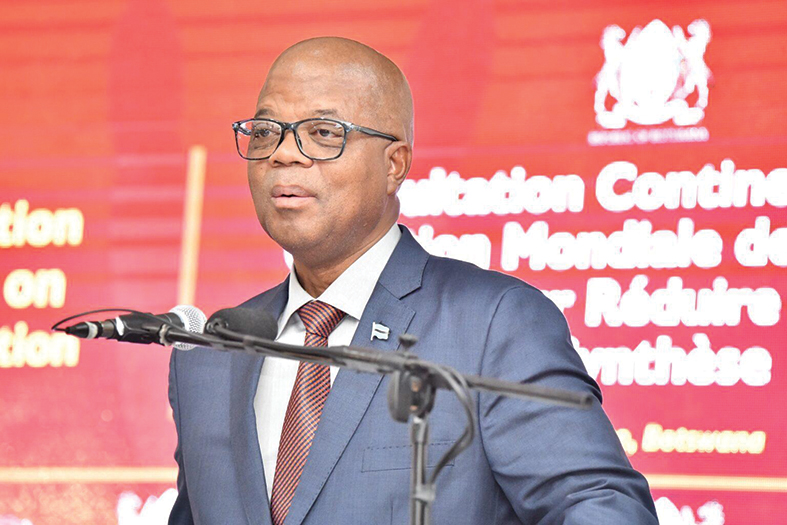
Minister for State President, Defence and Security, Moeti Mohwasa argued that democracy must be felt in people’s everyday lives beyond elections and institutions, warning that poverty, inequality, and exclusion threaten it, and that technology, media, and leaders must serve the people rather than control them. “At the heart of democracy, the simple but powerful conviction that public authority must serve the people, not control them,” he said, adding that democracy must be more than elections and institutions it must be felt in citizens’ daily lives, rooted in the kgotla tradition of participation, accountability, and dignity.
He warned that poverty, inequality, and exclusion threaten democracy itself, while stressing that technology, media, and leaders must serve the people rather than control them, calling for media self-regulation, inclusion of women, youth, and minorities, and a culture where disagreement is part of democracy, not a sign of failure.
Dr Ann-Christine Vossberg-Straw, an astrophysicist turned democracy practitioner, shared her personal journey from studying complex systems and cosmic structure formation to working in democracy, driven by encounters with inequality and a desire to understand how people can organise themselves so that everyone’s needs for safety, dignity, belonging, voice, and agency are met. She used the metaphor of galaxies and large-scale cosmic structures to illustrate that while individuals are like single particles, collective vision reveals patterns and possibilities that no one person can see alone.
She invited the audience to share what brings them to the forum and what they hope could emerge from it, emphasising that democracy is a shared undertaking requiring collective courage and connection. “We are one species and whatever structures we build, underneath them, we are one species, we’re not galaxies and we get a say.”
Judge of the High Court of Botswana, Justice Professor Tachilisa Balule told the conference that Africa needs substantive democracy, not mere elections, warning that weak rule of law undermines economic development across SADC, the EAC, and ECOWAS. He called for stronger regional courts, criminalising constitutional manipulation, and shielding economic treaties from political instability.
“Africa does not just need elections; it needs substantive democracy, when that contract is violated through flawed electoral processes, the economic foundation of the state fractures,” he highlighted.
Across Africa’s sub-regions, people are still grappling with what democracy really means in their daily lives not just on election day, but in whether their voices are heard, their rights protected, and their futures secure. Conversations keep returning to familiar struggles: constitutions that promise much but deliver little, courts that lack the power to enforce, economies that exclude rather than include, and the growing pressure of climate change on already fragile livelihoods.
The common thread is a quiet but urgent demand that democracy should not be a ritual of voting every few years, but a lived experience of dignity, fairness, and belonging for ordinary people.