
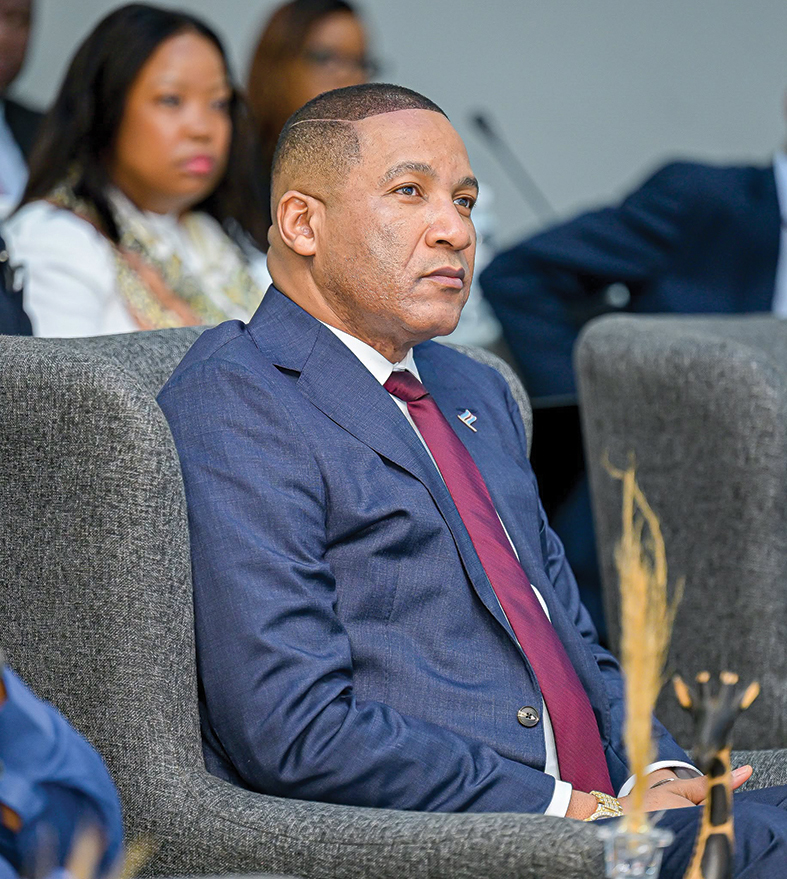
SOLOMON TJINYEKA
President Duma Boko’s announcement that the government intends to return 52,000 square kilometres of ancestral land in the Central Kalahari Game Reserve (CKGR) to indigenous communities has attracted widespread applause, but also sparked debate among conservationists and other commentators.
During his State of the Nation Address (SONA), Boko described the proposed restitution as the largest structured restitution of land rights to an indigenous population within a protected area on the African continent.
The announcement has been welcomed by advocates of indigenous rights, particularly those representing the San, who have historically faced displacement from their ancestral territories.
However, the proposal has raised concerns about its implementation, with some conservationists warning that it could create competing land claims by other communities that were also displaced from protected areas.
The Regional Chairperson of the Indigenous Peoples of Africa Coordinating Committee, Khoebee Satau, described the government’s commitment as a significant shift from historical dispossession towards restorative justice.
Satau said the decision represents an important opportunity to acknowledge the rights, identity and cultural heritage of the San, particularly the G||ana and G|ui communities.
He noted that for decades, the San have struggled to preserve their cultural identity against policies of forced assimilation, arguing that relocation, often justified in the name of development and conservation, had effectively weakened their connection to ancestral lands.
“Land restitution acts as a formal state recognition of their indigeneity. It signals that their way of life is not a relic to be erased, but a valid culture that relies fundamentally on access to ancestral territory,” he said.
Satau explained that land holds deeper significance for the San beyond its economic value, describing it as an archive of their history and the foundation of their spirituality.
However, Satau stressed that the success of the proposed restitution would depend on how the government implements the commitment.
He called for meaningful access to ancestral land, and protection against external interests, particularly mining and tourism operations that could undermine indigenous communities’ rights while prioritising commercial interests.
Satau also emphasised the need to restore basic and culturally appropriate services to ensure that communities returning to their ancestral territories can live sustainably.
Indigenous Peoples and Local Communities Advocacy and Communications Officer at Community Leaders Network, Job Morris, said the announcement is one of the most significant developments in Botswana’s contemporary human rights and land governance discourse.
Morris said it represents an important political commitment to addressing historical injustices that have affected the San people and other Indigenous communities for generations.
He stressed that their struggle to remain connected to their ancestral territories has been characterised by years of displacement, legal challenges, resistance and an enduring determination to protect their identity, culture and relationship with the land.
Meanwhile, renowned conservationist and Professor at the Okavango Research Institute in Maun, Joseph Mbaiwa, has cautioned the government against the proposed return, arguing that it could create complex land ownership and conservation challenges.
Mbaiwa said while he supports community rights, he does not support them blindly, warning that the decision could open what he described as a Pandora’s Box of competing ancestral land claims.
He argued that other Basarwa communities in Ngamiland, particularly those from Gudigwa and Khwai, who were allegedly forcibly removed from their ancestral lands in Moremi Game Reserve, could also demand similar treatment.
“If you say those Basarwa should return to CKGR, it means that those in Ngamiland should return to Moremi. The law of the country should apply to everyone, not only those in CKGR,” he said.
Mbaiwa further argued that other communities, including the Batawana and Bayei, could also advance claims over Moremi Game Reserve, while communities previously residing in Chobe National Park could seek similar recognition.
“I am also for Basarwa to be given special dispensation, but for them to return to CKGR, I don’t support that,” he said.
Mbaiwa further warned that allowing communities to return to national parks could undermine conservation and tourism activities.
He questioned whether the government had conducted an assessment to establish how many Basarwa actually wish to return to the CKGR, arguing that many communities have since adopted different livelihoods.
He also pointed to communities in Xade and Kaudwane, among other settlements in the Kgalagadi District, where Basarwa have been allocated ranches and have established livelihoods involving livestock.
“Basarwa are now living completely different lives. If you say Basarwa should return to CKGR, are you going to make CKGR a town? Should we kill our conservation areas?” he questioned.
Meanwhile,Kebareeditse Ntshogotho, a fellow Mosarwa from Khwai, also supported Professor Mbaiwa’s position, saying the Khwai community would formally inform the President of their intention to return to their ancestral land in Moremi Game Reserve, from which they were allegedly forcibly relocated at gunpoint by the government.
Ntshogotho said they appreciate the government’s decision regarding the CKGR, arguing that it has opened the door for other indigenous communities to pursue similar claims to their ancestral lands.