
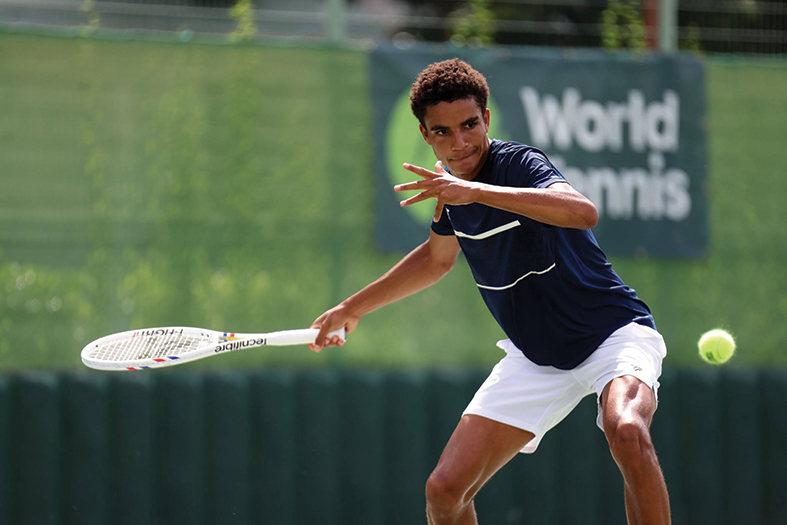
Tennis prodigy Ntungamili Raguin
STAFF WRITER
Reaching a career-high junior world ranking of No. 21 at just 17 years old is a historic milestone for Botswana tennis, but the father and manager of prodigy Ntungamili Raguin insists that talent alone cannot bridge the gap to the grueling senior ATP Tour.
Responding to questions asked by this publications this week on the steep structural hurdles confronting young athletes globally, he outlined a patient, strategic development roadmap as his son enters his final year of junior eligibility in 2027.
While acknowledging the vital support already provided by Orange Botswana and Tecnifibre, Dominique pointed out that building a self-sustaining touring professional requires a far more robust, long-term commercial foundation. He believes local corporations and public institutions must step up to anchor this framework early.
“The most valuable sponsorship for a young athlete is not necessarily the one that arrives once he has become a star, but the one that helps him become one,” Dominique noted, citing the heavy capital required for international logistics, elite coaching, and medical networks. “For Botswana’s corporate sector and public institutions, this is an opportunity to invest in a promising young athlete who could represent the country internationally for many years to come.”
This vision directly intersects with the current goals of the Botswana Tennis Association (BTA). BTA President Oaitse Thipe confirmed that the governing body is actively collaborating with the Raguin family to secure both domestic and global corporate alliances.
Thipe also made a direct appeal for increased state funding, arguing that the international visibility Ntungamili brought to the country during his runs at Wimbledon and the Australian Open represents invaluable national promotion. “You can’t put a price tag to it,” Thipe emphasized.
The BTA views the young star’s progression as a critical asset for the nation’s broader tennis ambitions. “Ntungamili will be vital in our Davis Cup team in the coming years. We intend to play higher groups, therefore his experience playing Grand Slams will be really good for the growth of our national team.” Thipe explained.
The operational plan relies on a deliberate competitive balance, coordinated alongside coaches Killian Sinclair and Thomas Enqvist. The groundwork has already begun; earlier this year, Ntungamili secured his first ATP ranking point with a debut professional match victory at the M15 tournament in Gaborone.
“In 2027, he will turn 18, meaning it will be his final year of eligibility on the international junior circuit. Our intention is to take advantage of that last junior season, particularly the Grand Slams, while progressively increasing his participation in professional tournaments.” Dominique said.
The strategy treats the junior Grand Slams as essential arenas for building an international profile, while increasing exposure to professional events to accustom the teenager to senior opposition.
“We don’t want to rush the transition, but we don’t want to delay it unnecessarily either. The objective is not simply to achieve the highest possible junior ranking. It is to prepare Ntungamili to become the best professional tennis player he can be.”
On-court execution falls under the guidance of Coach Killian Sinclair, who stresses that the senior circuit demands an entirely different tier of physical endurance and tactical consistency. Sinclair’s camp, working alongside physical trainer Benjamin Sénac, is prioritizing a measured, long-term approach to athletic conditioning.
“Professional players are generally stronger, more experienced and capable of maintaining a very high level of performance throughout long matches,” Sinclair observed. “At 17, he is still developing physically. One of his strengths is his exceptional ability to learn, adapt and implement what we work on in training, which is very encouraging for his long-term development.”
Sinclair also points out that transitioning from junior stardom to the bottom rungs of the professional circuit requires immense psychological resilience and humility.
“One of the biggest challenges for successful junior players is understanding that their junior achievements do not automatically translate into success on the professional circuit,” Sinclair said. “Players also have to understand that progress is not always reflected immediately in their results or rankings.”
To foster this mindset, the coaching staff is emphasizing daily standards and continuous learning, using Ntungamili’s past high-pressure experiences—including major junior tournaments and Davis Cup duties—as fundamental milestones.
Amid growing local excitement, Dominique remains focused on insulating the 17-year-old from the weight of carrying an entire country’s tennis aspirations.
“We certainly don’t want him to feel that he is carrying the entire future of Botswana tennis on his shoulders. He should be proud to represent Botswana, but he should never feel that he has to win in order to make Botswana proud. If his journey can inspire other young Batswana to believe that they too can compete internationally, that would already be a wonderful achievement. ,” Dominique insisted.
Beyond individual results, the BTA hopes to translate Raguin’s rising profile into a sustainable grassroots legacy across the nation.
“We are planning with World Tennis to donate new tennis equipment to schools around Botswana with him around, or possibly conduct schools tennis camps with him and Orange Botswana to grow the sport,” Thipe revealed, outlining a community-focused initiative designed to cultivate the sport’s next generation.